
FASTTRACK DSCR · INVESTOR GUIDE
Is PadSplit Profitable? How to Underwrite a Rent-by-the-Room Rental Before You Buy
Investor Math vs. Instagram Math
Higher room income can look spectacular—until vacancy, platform fees, utilities, and lender underwriting enter the picture.
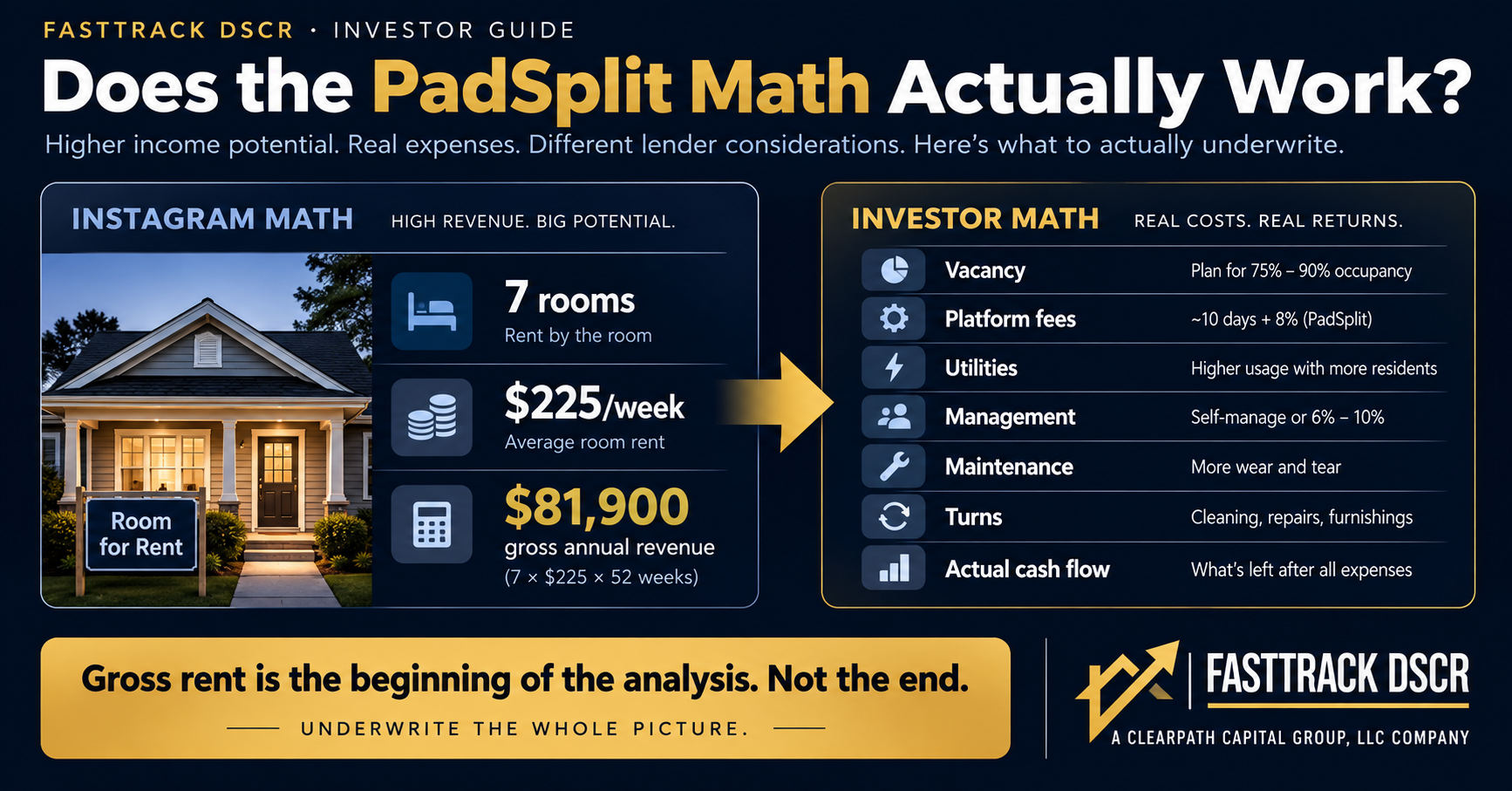
Seven bedrooms at $225 per week can look spectacular on a spreadsheet. Unfortunately, gross rent has never paid a water bill.
A PadSplit, co-living or other rent-by-the-room property can produce meaningfully higher gross revenue than leasing the same house to one household. But the number that matters is not rooms multiplied by advertised weekly rent. It is collected revenue minus realistic expenses and financing costs.
There is one more wrinkle for DSCR borrowers: the rent a property actually collects may not be the same rent a lender uses to calculate DSCR. That is why a PadSplit deal needs two models: investor underwriting (does it produce attractive cash flow?) and lender underwriting (does the financing qualify?).
Start with realistic room revenue
The simplest calculation is rentable rooms × weekly room rent × 52. Seven rooms at $225 per week produce $81,900 in potential annual room revenue at 100% occupancy. That is not the number to use to decide whether to buy.
At 85% occupancy, estimated collected room revenue is $69,615 per year, or about $5,801 per month before expenses. PadSplit’s host FAQ has reported platform-wide occupancy above 90% and an average member tenure of about eight months, but those figures are not guarantees for any individual property. Run several occupancy scenarios.
| Occupancy assumption | Collected annual room revenue |
|---|---|
| 75% | $61,425 |
| 85% | $69,615 |
| 90% | $73,710 |
If the investment only works at 95% occupancy, it leaves very little room for error.
Research what each room will actually rent for
Do not ask, “What is the highest PadSplit rent I can find?” Ask, “What would a renter realistically pay for this particular room, in this house and location?” Consider the neighborhood, employment and transit access, room size, private versus shared bathroom, parking, furnishings, competing listings and the number of people sharing common areas.
A private-bath primary bedroom may command a premium. A converted dining room beside the kitchen probably will not. Verify that each proposed room is legal and practical under applicable local occupancy and building rules.
PadSplit platform fees and turnover belong in the model
PadSplit’s published host fee model (updated July 2026) is commonly described as “10 days + 8%”: the first 10 days of dues for a newly placed member as a booking fee, followed by an 8% service fee on applicable collected payments. PadSplit’s earnings FAQ explains how fees apply to settled payments and certain transfers or referrals. Verify current terms and exceptions directly before buying; platform fees can change.
At $225 per week, 10 days of dues is approximately $321 for a new occupancy. If residents remain longer, that cost is spread over more months. If rooms turn frequently, it recurs more often. Move-in fees may offset some preparation costs, but should not be treated as pure profit.
Utilities, cleaning and maintenance are real expenses
Member pricing often includes utilities and Wi-Fi. The owner must budget for electricity, water, sewer, gas, internet, trash and seasonal spikes. A home occupied by seven unrelated adults may consume considerably more than a conventional single-family tenancy.
Higher occupancy can also mean more wear on plumbing, appliances, bathrooms, locks, flooring, HVAC and common areas. Include common-area cleaning, repairs, furnishings and replacement reserves. In the example below, utilities are assumed at $650 per month, cleaning at $300 per month and repairs at $350 per month. These are hypothetical planning assumptions, not PadSplit requirements.
Management does not disappear because there is an app
A platform can help with listings, screening, collections and technology, but someone still coordinates repairs, vendors, resident issues, room turns and house standards. If you self-manage, value your time. If you hire management, include the cost. This illustration uses management at 8% of collected room revenue, approximately $5,569 annually.
Conversion, furnishings and compliance costs affect the return
A co-living property may require bedroom conversions, code-compliant egress, locks, beds and mattresses, storage, bathrooms, Wi-Fi equipment, utility upgrades, fire-safety work and permits. These costs belong in the initial investment basis. Spending $25,000 to generate $15,000 of additional stabilized annual cash flow is a very different proposition from spending $75,000 to achieve the same result.
A realistic seven-room PadSplit underwriting example
The following is an illustrative model, not an actual property or a guarantee of performance.
| Revenue assumption | Annual amount |
|---|---|
| 7 rooms × $225/week × 52 | $81,900 potential gross |
| Occupancy assumption | 85% |
| Collected room revenue | $69,615 |
| Operating expense | Annual estimate |
|---|---|
| PadSplit booking/service fees | $8,200 |
| Utilities | $7,800 |
| Cleaning/common-area support | $3,600 |
| Repairs and maintenance | $4,200 |
| Management | $5,569 |
| Property taxes | $3,600 |
| Insurance | $2,400 |
| Replacement/capital reserve | $2,400 |
| Total operating expenses and reserves | $37,769 |
Estimated operating cash flow before mortgage debt: $69,615 − $37,769 = $31,846 annually, or approximately $2,654 per month. This includes a replacement-reserve allowance and is not the same as a formal appraisal NOI calculation. It also excludes debt service, acquisition and conversion costs, and income taxes.
The $8,200 platform-fee line is an illustrative turnover-and-service-fee budget, not a universal fee or a prediction of actual member turns. Actual charges depend on move-ins, settled payments, and applicable exceptions.
That is a more useful starting point than advertising $81,900 of gross rent. Gross rent is the beginning of the analysis, not the end.
The financing issue many investors miss
Suppose the house collects roughly $5,800 a month through room rentals. It is tempting to assume the lender will use that amount for DSCR. Maybe—but not necessarily.
Some specialty lenders may consider documented aggregate room revenue, operating history, rent rolls, platform statements and deposits. Others may finance the property but qualify it using the appraiser’s whole-house market rent. Some lenders may not accept the rent-by-room structure at all. Property eligibility and qualifying-rent methodology are separate issues.
For example, assume the house would rent traditionally for $2,400 per month and proposed monthly PITIA is $2,200. A lender using whole-house market rent calculates $2,400 ÷ $2,200 = 1.09 DSCR, even if the actual room rentals collect about $5,800 monthly. Both figures can be true because they measure different things.
Some specialty low-DSCR or no-ratio programs may offer alternatives, but leverage, credit, property eligibility, reserves and pricing remain lender-dependent. Confirm the lender’s rent methodology before relying on financing. See our PadSplit and co-living DSCR financing guide for program considerations.
Eight questions to answer before making an offer
- What would the house rent for under a traditional single-family lease? This provides a fallback strategy and may be the lender’s qualifying rent.
- How many rooms are legal and practical under local building, occupancy, egress and parking rules?
- What do competing rooms actually rent for in that neighborhood?
- What happens to cash flow at 75%, 85% and 90% occupancy?
- What will utilities, cleaning, repairs, furnishings and reserves realistically cost?
- Who will manage the property, and at what cost?
- What will the conversion, setup, permits and compliance work cost?
- How will the specific DSCR lender calculate qualifying rent?
Run two models before you buy
Investor underwriting should include room revenue, vacancy, platform fees, utilities, cleaning, management, repairs, turnover, taxes, insurance, reserves and conversion costs.
Lender underwriting should include qualifying rent, PITIA, DSCR, FICO, LTV, reserves, operating history and whether the rental structure is permitted. FastTrack’s DSCR Calculator can help estimate coverage, but the lender’s qualifying-rent methodology must be confirmed.
That is where LenderMatch™ can help FastTrack identify the programs worth exploring. A strong PadSplit investment does not simply need a lender; it needs one whose guidelines fit how the property actually operates.
Bottom line
The better question is not “How much rent can this house generate?” It is “How much durable cash flow will this house produce after expenses—and will the financing still work under the lender’s rules?”
Gross rent is the beginning of the analysis. Not the end.
Have a PadSplit or co-living property you're evaluating?
Submit a quote request at FastTrack DSCR and we’ll review the complete scenario through LenderMatch™ to identify the DSCR options worth exploring.
Business-purpose investment properties only. Program availability, qualifying-rent methodology, leverage, rates, fees and underwriting requirements vary by lender. Illustrative operating assumptions are not projections, investment advice or commitments to lend.